
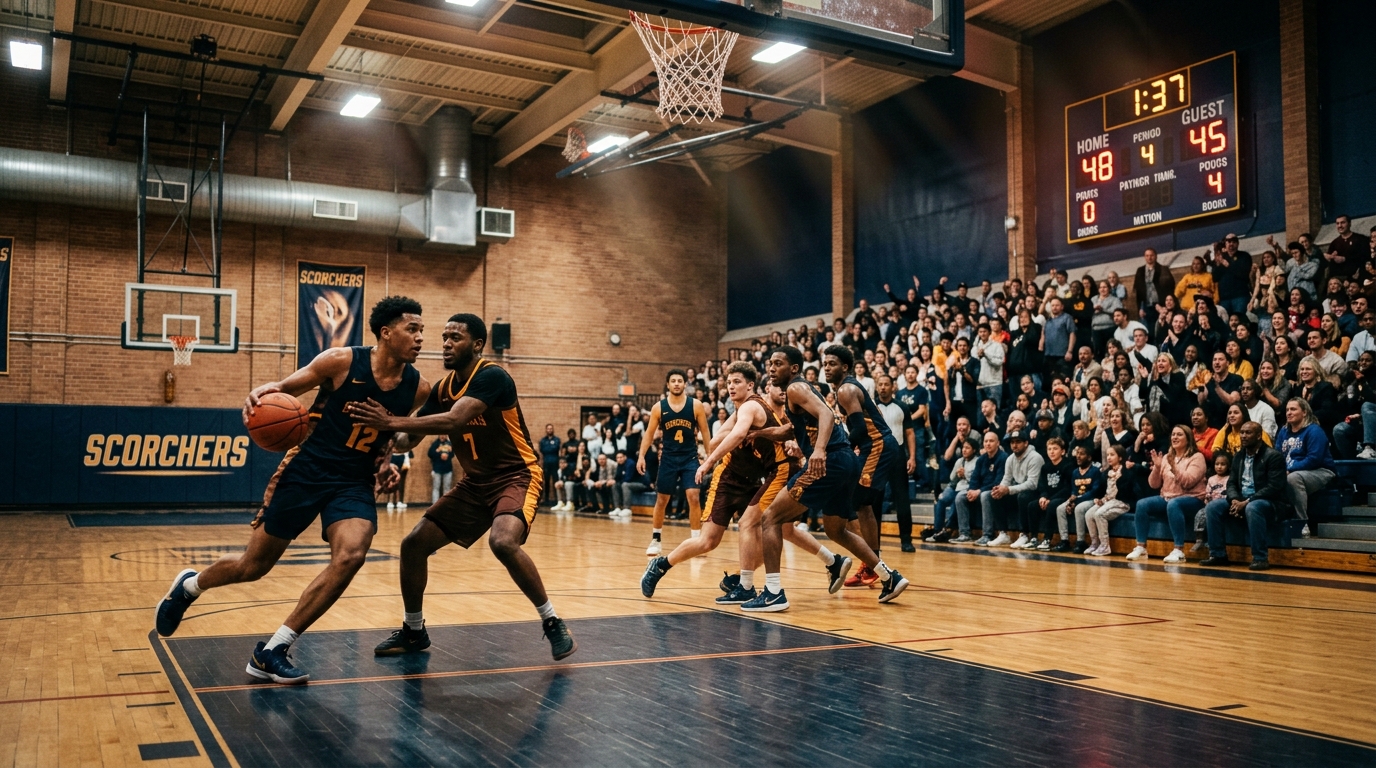
Basketball League Scheduling: Practical Tips for Rec and Competitive Leagues
How to schedule a basketball league season — gym time optimization, double-headers, referee coordination, and the constraints unique to basketball.
Basketball league scheduling has its own rhythm. Gym time is scarce, games run a predictable 60–90 minutes, and most leagues stack 4–6 games on a single weekend day to maximize court use. This guide covers the constraints unique to basketball and the patterns that work.
The defining constraint: gym time
Most rec leagues don't own a gym — they rent court time from a school, community center, or sports facility. That rental is usually a fixed block: "Court 2, Saturdays 9 AM to 5 PM." Everything else flows from that.
For an 8-hour rental block with 90-minute game slots (60 min play + 30 min buffer), you can fit roughly 5 games per day. Multiply by your number of Saturdays and you have your total game budget.
The standard one-court schedule
For a 6-team round robin (15 games) on one court running 5 games per Saturday:
- Week 1: Games 1–5
- Week 2: Games 6–10
- Week 3: Games 11–15
- Week 4: Playoffs (semis + final)
Total: 4 Saturdays. Clean, simple, predictable.
Parallel courts unlock everything
If your venue has 2+ courts, the math compounds. 8 teams in a round robin (28 games) becomes feasible in just 4 weeks across two courts at 4 games per day. Adding a third court cuts that to 3 weeks.
Double-headers vs single games
Some leagues schedule each team for two back-to-back games on the same day, every other Saturday. Pros: fewer total weeks, parents only commute biweekly. Cons: player fatigue, especially in the second half of the season.
Most rec leagues stick with one game per team per day for U12 and below; competitive leagues sometimes adopt double-headers for older divisions.
Officiating: the hidden bottleneck
Basketball needs at least one referee per game. Two refs is standard for competitive play. Three refs is the federation gold standard. Cost: usually $30–$60 per ref per game.
Smart leagues build the officiating into the schedule. Either:
- Hire paid refs and pre-assign them to specific games — schedule the ref assignment column in your spreadsheet
- Rotate teams — team A officiates team B's game while waiting for their own. Cheaper but lower quality
Scoring and statistics
Modern basketball leagues track more than just wins and losses. The progression:
- Score-only — just final scores, used for standings
- Box scores — per-player points, rebounds, assists; entered after each game
- Live stats — a designated scorekeeper records every stat as it happens
Step 3 produces something genuinely valuable — a public leaderboard, career stat sheets, season awards. Schedule Guru's Pro tier ships with a full live stat tracker built for basketball.
Common basketball scheduling mistakes
- No buffer between games. Even pickup games need 15+ minutes to clear and resurface. Schedule 30.
- Booking the gym for the championship game without checking final scheduling. The championship needs a single court with all eyes on it, not a parallel-courts setup.
- Ignoring referee availability. The best refs are scarce. Confirm your officiating crew before publishing the schedule.
- Forgetting playoffs. Build playoff weeks into the schedule from day one — leaving them for "after the regular season" leads to rushed planning.
Tournament formats that work for basketball
Round robin + playoffs — most common. Regular season is round robin, top 4 or 8 teams advance to single elimination.
Pool play + bracket — for large weekend tournaments. Pools of 3–4 teams, top finishers cross to a bracket.
Single elimination with consolation — for one-day tournaments where every team needs at least two games. The "3-game guarantee" format is built on this.
Build your basketball schedule
Schedule Guru's basketball league builder handles all common formats with full referee notes, box-score import, and a public share URL. Free for up to 8 teams.
FREQUENTLY ASKED QUESTIONS
How long does a recreational basketball league season last?
How much buffer time should I schedule between basketball games?
START BUILDING YOUR TOURNAMENT SCHEDULE
Free for up to 8 teams. No credit card. Public share URL + PDF, Excel, and iCal exports included.
Schedule Guru Team
Helping sports organizers create better tournaments with our free round robin schedule generator.