
Volleyball Tournament Scheduling: A Complete Guide for Directors
The specific challenges of volleyball tournament scheduling — court rotations, referee assignments, double-headers — and how to plan around them.
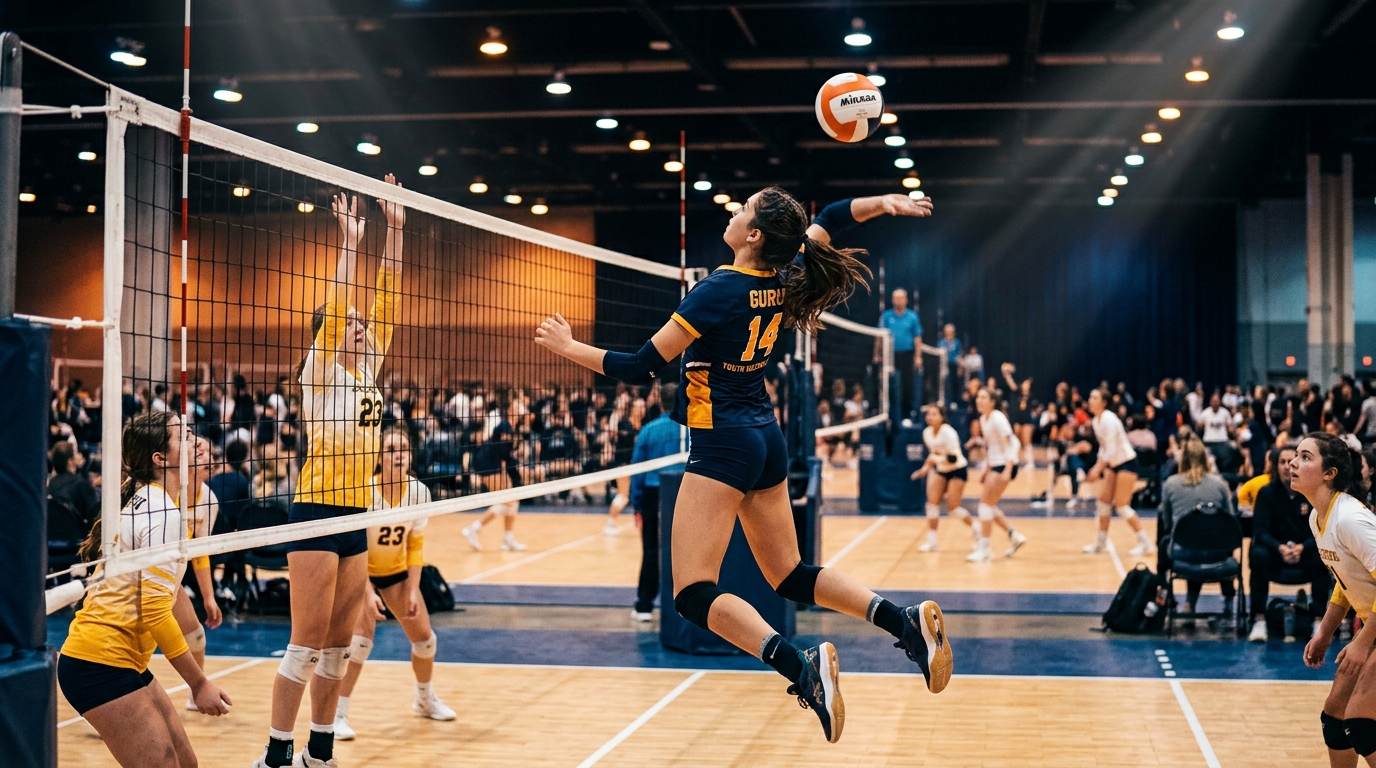
Volleyball tournaments have their own operational rhythm. Unlike basketball or soccer, where each game commands a full court for a fixed duration, volleyball runs as a series of short matches with rapid rotations across multiple courts. Done right, a club tournament can run 60 matches in a single day. Done wrong, you have empty courts, idle officials, and unhappy parents.
What makes volleyball scheduling different
- Match length varies. A best-of-three match can finish in 35 minutes or take 75 minutes. Schedules need buffer.
- Court density is high. One gym usually hosts 2–4 courts simultaneously, and they all need games scheduled in parallel.
- Officials are scarce. Most volleyball tournaments rotate officials across courts, so the schedule has to account for who's available to ref when.
- Warm-up time matters. Each team needs 8–10 minutes of court time before their next match.
The two formats that dominate volleyball
Pool play with crossover bracket is the gold standard. Teams play 3 matches in their pool, top finishers advance to a single elimination bracket. Used by every major club tournament.
King-of-the-court round robin for small tournaments (4–6 teams) where everyone needs to play everyone. Less common but useful for one-day events.
Building a one-day volleyball tournament schedule
For an 8-team, 4-court, one-day tournament:
- 9:00 AM — Pool play begins. 4 pools of 2 teams across 4 courts, parallel. Or: 2 pools of 4 teams playing 6 games each across 4 courts.
- 12:00 PM — Pool play ends. Quick seed verification.
- 12:30 PM — Lunch.
- 1:30 PM — Quarter-finals (4 matches across 4 courts).
- 3:00 PM — Semi-finals (2 matches, 2 courts).
- 4:30 PM — Final (single court, all spectators).
- 5:30 PM — Trophy ceremony.
Total: 27 matches in 8 hours. Tight but doable.
Court allocation strategies
Two strategies for assigning matches to courts:
Random rotation — every team plays at least one match on every court. Feels fair. Good when court quality varies (e.g., one has a better net height).
Pool-to-court — each pool plays all their matches on a single dedicated court. Simpler logistically; teams know exactly where to go. Good when you have nervous first-time players.
Referee scheduling
Most volleyball tournaments use either paid officials or rotating teams (team A officiates team B's match while waiting for their own). Either way, the schedule needs an "officiating" column alongside the "home" and "away" columns. Schedule Guru lets you add a Notes field to each match — use it to assign the officiating team or named referee.
Common mistakes
- Back-to-back matches with no warm-up. Every team needs 8–10 minutes between matches. Schedule the buffer.
- Pool play that ends right at lunch. The standings are usually finalized about 20 minutes after the last pool game. Build that gap.
- Forgetting that the final is one court only. The other courts sit idle. Sometimes that's fine; sometimes you stack a consolation bracket onto the empty courts.
- No make-up time. A best-of-three that goes to a 27-25 third set will run 75 minutes. Pad for it.
The technology that helps
A tournament scheduler designed for sports — not a generic calendar tool — will:
- Distribute matches across your court count automatically
- Track best-of-three series with multiple set scores
- Update standings in real time as scores are entered
- Generate a printable PDF for the gym wall
- Provide a public URL so spectators don't ask the score desk every five minutes
Schedule Guru handles all of this for round robin, pool play, and single/double elimination volleyball formats. Build your tournament schedule in about five minutes.
Multi-division tournaments
Club volleyball commonly runs 4–6 age divisions simultaneously (12U, 14U, 16U, 18U). The trick is keeping each division logically separate while sharing the same courts and time slots. Use Schedule Guru's pool play feature with multiple events — one per division — and assign each event its share of court time on the master schedule.
FREQUENTLY ASKED QUESTIONS
How long does a volleyball match take?
What is the best tournament format for volleyball?
START BUILDING YOUR TOURNAMENT SCHEDULE
Free for up to 8 teams. No credit card. Public share URL + PDF, Excel, and iCal exports included.
Schedule Guru Team
Helping sports organizers create better tournaments with our free round robin schedule generator.