
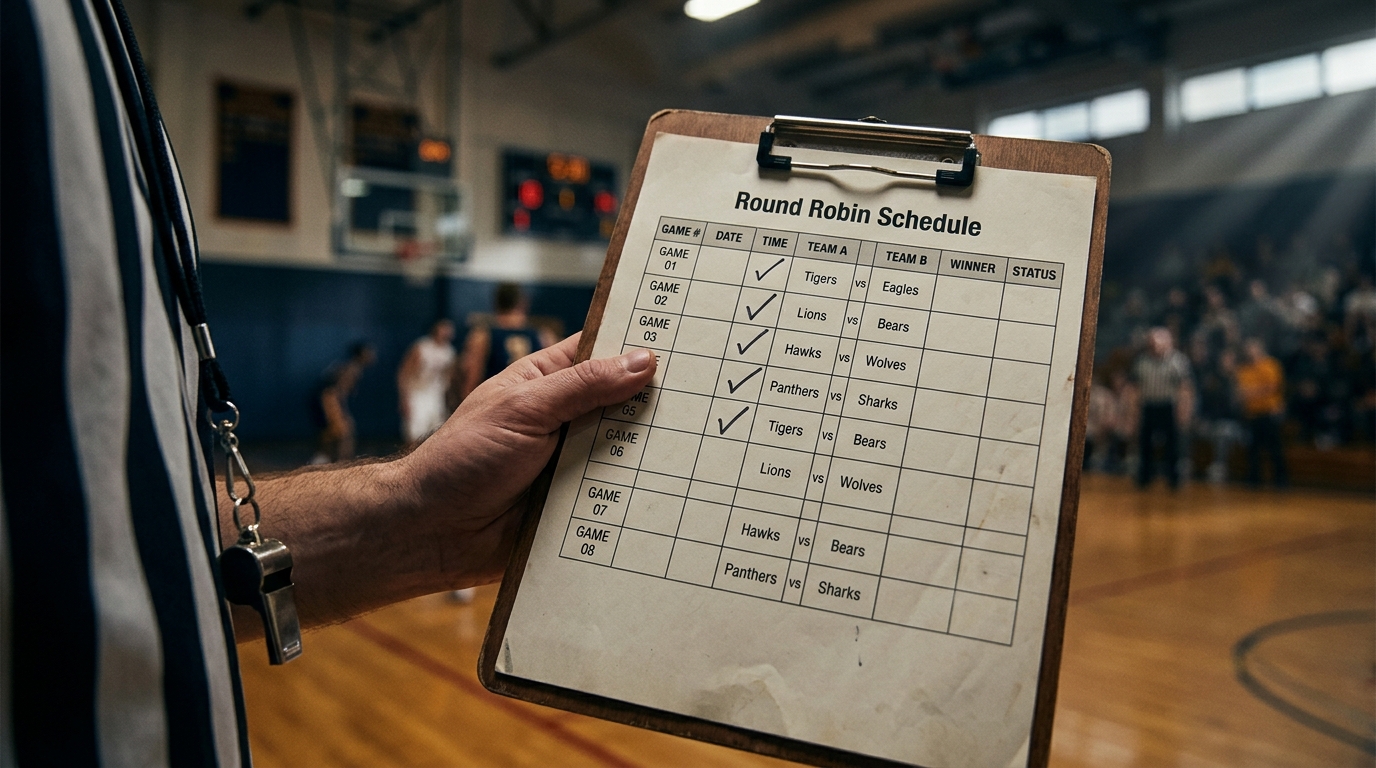
The Ultimate Guide to Round Robin Tournaments
Everything you need to know about round robin tournaments — the format, the math, the trade-offs, and how to run one without losing your weekend.
Round robin is the most-used tournament format in sports for a simple reason: it's the fairest one. Every team plays every other team, the standings reflect actual head-to-head results, and a single bad game doesn't end your season. This guide covers what a round robin is, when to use one, and the operational details that make the difference between a smooth tournament and a chaotic one.
What is a round robin tournament?
A round robin is a tournament format where every participant competes against every other participant exactly once (single round robin) or twice (double round robin, usually home-and-away). The team with the best record after all matchups is the champion, with tie-breaking rules deciding ties.
It's the format used by virtually every major professional league's regular season — the NBA, the Premier League, La Liga, the NFL division stage — because over many games, the win-loss record reliably reflects the better team.
When to choose round robin format
- Skill levels are reasonably matched. If one team is clearly dominant, every game becomes a foregone conclusion.
- You have time. A round robin requires more games than an elimination bracket. Plan for at least three weekends with 4–8 teams.
- Every team deserves equal opportunity. No "you lost your first game, see you next year" — every team plays the full schedule.
- You want meaningful standings. The standings table tells a real story after a round robin, not just a tournament-bracket result.
The math behind a round robin
The number of games in a single round robin equals n × (n − 1) / 2 where n is the team count.
- 4 teams → 6 games
- 6 teams → 15 games
- 8 teams → 28 games
- 10 teams → 45 games
- 12 teams → 66 games
Double those numbers for a double round robin. The game count grows quadratically, which is why round robins past 12 teams usually split into multiple pools — see our pool play guide for that pattern.
What can go wrong
Most round robin headaches come from three places:
- Schedule conflicts. Without an automated generator, balancing home/away, equal rest, and venue availability is a four-hour spreadsheet exercise. A good round robin schedule generator handles all of this in seconds.
- Tie-breakers that weren't pre-announced. When two teams finish 5-2 with a head-to-head split, coaches will argue. Publish your tie-breaking rules before the first game.
- Mid-season changes. A team drops out, a weather cancellation, a forfeit. Have a written policy for each before you start.
Best practices that save real time
From running federation-scale tournaments, the practices that consistently pay off:
- Pre-build at least one make-up date into every schedule. You will need it.
- Publish a shareable URL, not a PDF. Schedule changes are inevitable; a live URL stays in sync, a PDF doesn't.
- Subscribe everyone to the iCal feed. Most parents and players never check the website twice — calendar subscriptions update silently.
- Track point differential as a tie-breaker. Awarding it openly encourages good teams to keep competing even when blowouts feel academic.
Round robin vs other formats
Single elimination is faster (n − 1 games for n teams) but eliminates teams after one loss. Best for one-day tournaments.
Double elimination is fairer than single elim but more complex. Best when you can't run a full round robin.
Pool play + bracket combines round robin groups with an elimination playoff. Best when you have 12+ teams.
For the full comparison, see our 2026 tournament format guide.
Generate your first round robin schedule
The fastest way to grasp the format is to build one. Start a free round robin schedule for 4–8 teams with Schedule Guru — no signup required, PDF and iCal exports included.
FREQUENTLY ASKED QUESTIONS
What is the formula for a round robin tournament?
Is round robin better than single elimination?
START BUILDING YOUR TOURNAMENT SCHEDULE
Free for up to 8 teams. No credit card. Public share URL + PDF, Excel, and iCal exports included.
Schedule Guru Team
Helping sports organizers create better tournaments with our free round robin schedule generator.